How to Track Your Aerial Hoop Progress (and Actually See Improvement)
Almost every aerialist I know has had the same conversation with themselves. It usually happens around month six. You walk out of a class, sit in your car, and think: Am I getting better? I can't tell.
Aerial hoop is a sport where the gains are real but invisible. Each class adds a sliver of strength, a small refinement in a pose, a slightly cleaner transition. You don't notice any of it in the moment. You only notice it three months later, when something that used to feel impossible feels merely difficult — and you've forgotten what "impossible" felt like.
This article is about closing that gap. About building tracking habits that turn invisible progress into visible progress. The aerialists I see staying motivated through plateaus are not the ones with more talent. They're the ones who can see the line moving.
Why aerial progress feels invisible
Three reasons your improvement is harder to see than it should be.
The gains are too small to notice in real-time. A pose that took 12 seconds to set up last month takes 9 seconds this month. Your shoulders feel slightly more confident in inversion. Your line in mermaid is two degrees closer to elegant. None of those changes register in a single class. They're below the threshold of in-the-moment perception.
Your reference point keeps moving. As you get better, your standard for "good" rises. The pose that felt amazing in month two now feels mediocre in month six because you can see what's wrong with it. That shifting standard makes it feel like you're not progressing, when in fact you've gained the perception to see your own gaps.
You're comparing yourself to performers, not to yourself. Five years ago. Six months ago. A year of training compresses in your memory into a single point: "I started." When the comparison is "performer on Instagram vs. me," progress feels invisible because the gap is enormous. When the comparison is "me three months ago vs. me today," progress is obvious. Most aerialists do the wrong comparison by default.
The fix for all three is the same: externalize your progress so you can see it without relying on your in-the-moment perception.
What "tracking" actually means
Tracking is not journaling everything. It's not a daily 1,000-word reflection. It's three small categories of data, captured consistently over time.
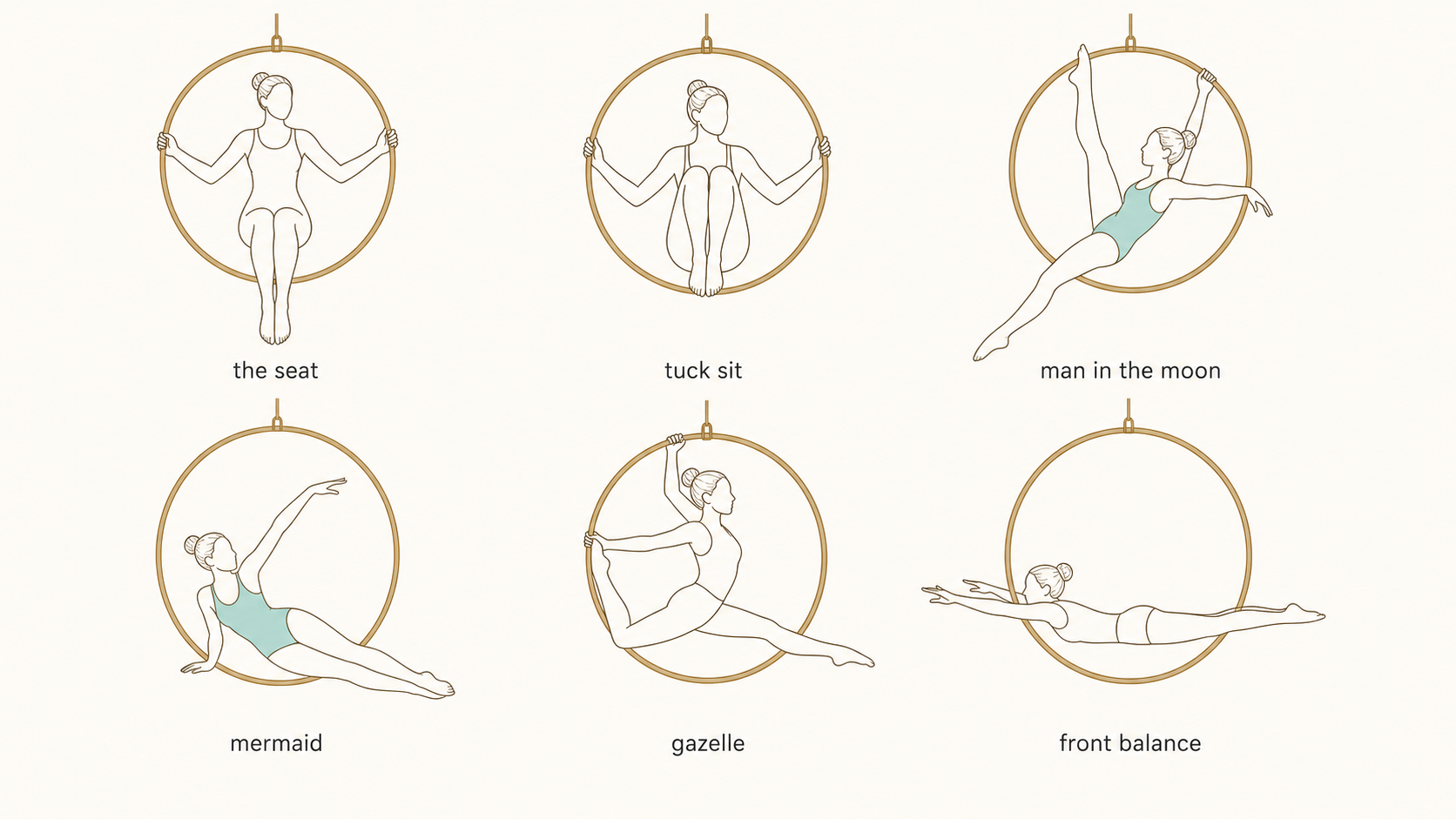
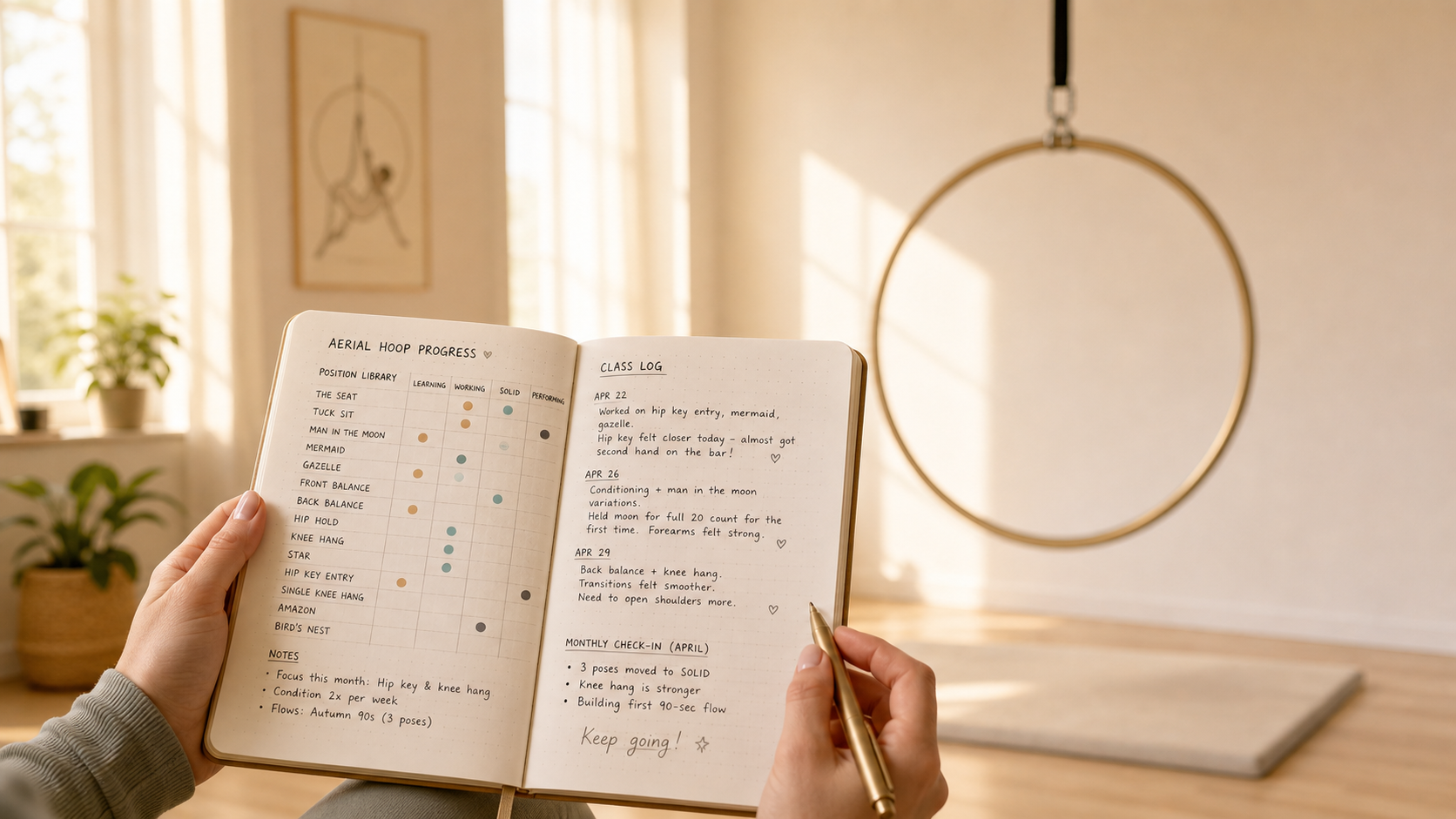
Category 1: Position library. Every aerial hoop pose has a name. You're either learning it, working on it, or it's solid in your body. A list of poses with a current status against each one is your position library. Reviewing it tells you exactly what you can and can't yet do.
Category 2: Class log. A two-line note after every class: what you worked on, what felt different. That's it. You're not writing an essay; you're capturing data points.
Category 3: Periodic check-ins. Once a month, ten minutes. Re-rate your library. Note what's moved from "working on it" to "solid." Record any flows or routines you've built. Pick one focus area for the next month.
That's the entire system. Three categories, low overhead, durable over time.
The position library
This is the single highest-leverage tracking tool in aerial. Most students don't have one. The ones who do progress visibly faster.
A position library is a list of every aerial hoop pose your studio teaches (or every pose you'd plausibly want to learn), with a status field next to each. A useful set of statuses:
- Locked — I haven't learned this yet.
- Learning — I've been introduced to it; I can do it with assistance or major form errors.
- Working on it — I can do it on my own, but it's not clean.
- Solid — Reliable. Clean. Repeatable on demand.
- Performing — I can hold this with full confidence in front of a camera or audience.
Why this works:
It makes plateaus visually different from regression. When you feel stuck, you can pull up your library and see: "I had three poses at 'working on it' last month. Two are now 'solid.' One has stayed at 'working on it.' I'm not stuck — I'm progressing on two skills and stalled on a third."
It tells you what to practice. "Working on it" is your training menu. Without a library, you practice whatever your instructor showed you most recently. With a library, you practice what's actually closest to becoming reliable.
It surfaces your actual vocabulary. Most aerialists overestimate how many poses they have. When they sit down to list them honestly, they discover that of the "fifty" poses they think they know, fifteen are solid, twenty are messy, and fifteen they don't really remember.
A pen-and-paper version works. A spreadsheet works. The Aerial Hoop Flow app was designed exactly around this idea — every position in the library, marked at your current level, filterable by difficulty, body part, or status. Whatever tool you use, the principle is the same: the act of writing a pose down at its current level is itself a training tool. It forces honest evaluation.
The two-line class log
The simplest, most underrated tracking habit in any movement discipline.
After every class, before you leave the studio (or in the car, or before bed), write two lines:
- What did I work on today? (Two or three poses, plus the focus of the day.)
- What felt different from last time? (One observation. Could be physical, technical, or emotional.)
Examples:
- "Worked on hip-key entry, mermaid, gazelle. Hip-key felt closer today — I almost got the second hand on the bar without dropping out."
- "Conditioning + man-in-the-moon variations. Held the moon for full 20 count for the first time. Forearms felt strong."
- "Hard class. Energy was low. Inverts were sloppy. Probably needed more sleep."
Two lines. That's the habit. After three months you'll have a written record of forty classes. Reading the first ten next to the most recent ten is the fastest way to convince yourself that the work is paying off.
The monthly check-in
Once a month, sit down for ten minutes with your library and your class log. The check-in has four parts:
Re-rate your library. Move poses between status levels honestly. Some poses get downgraded — you thought you had them, but you've avoided them for three months and they're rusty now. That's information, not failure.
Identify the trend. Are most of your gains in held shapes, in transitions, in conditioning, in flexibility? Patterns matter. They tell you what your training has emphasized — and what it's neglected.
Record any routines or flows you've built. A flow is a piece of work. It deserves an entry. Note the music, the poses involved, the date you finalized it, who you've performed it for. Future-you will want this list.
Pick one focus for the next month. Not three. Not five. One. "I'm going to make hip-key reliable." "I'm going to add ten seconds to my hollow hold." "I'm going to build my first 60-second flow." Single-focus months produce visible progress; multi-focus months feel busy and produce diffuse results.
What "improvement" actually looks like over time
Here's a realistic six-month progression for a beginner aerialist who tracks consistently. None of these milestones come from talent — they come from showing up and writing down.
Month 1. Library: 15 poses, mostly "learning." Two-line log started. First seat, tuck sit, mermaid feel less foreign.
Month 2. Library: 20 poses. Three poses moved to "solid." First hip-hold variations introduced. Conditioning twice a week becomes habit.
Month 3. Library: 25 poses. First inversion (knee hang). Two-line log shows clear progression in shoulder confidence. First clean photo of yourself in a pose.
Month 4. Plateau month. Hip-key not yet reliable. Library hasn't grown much. Reading the log reminds you that month 3 felt like a plateau too, and you broke through it. You break through this one.
Month 5. Hip-key arrives. Three new poses move to "solid." First three-pose flow built and performed for your trainer.
Month 6. Library: 35–40 poses, with 12–15 at "solid." First short choreography to music. Conditioning has measurably improved (longer hollow holds, easier inverts).
The month-4 plateau is the killer. Without tracking, that month feels like proof you've stopped progressing. With tracking, it's a normal-looking month flanked by two months of obvious gains, and you keep going.
What tracking is not for
A short word of warning. Tracking is a tool to help you see progress, not to manufacture it. Two failure modes to avoid.
Don't turn the library into a checklist arms race. The goal is not to maximize the number of "solid" poses. It's to develop a mature, reliable vocabulary you can use in choreography and performance. Twenty solid poses you can flow between cleanly are worth more than fifty messy "solid" poses.
Don't track to perform progress for an audience. Posting your tracking dashboard on social media every week turns an internal tool into external content, and the incentives shift. Track for yourself. Share when there's something genuine to share.
A simple tracking setup you can start today
If you've read this far and want to start, here's the minimum:
- Today (10 minutes): Open a note in your phone or a fresh page in a notebook. Title it "Aerial library." Write down every pose you've worked on. Mark each one learning / working / solid / performing. Be honest.
- After your next class (2 minutes): Add the two-line log entry. Date it.
- In a month (10 minutes): Sit down with both. Update the library. Read your log entries in order. Notice what's moved.
That's the entire commitment. Twelve minutes a month, plus two minutes after each class.
If you'd rather have it all in one place, with the position library, your training plans, your built flows, and a way to share routines with your coach, the Aerial Hoop Flow app is built around exactly this workflow. The 200+ positions are pre-loaded; you just mark your level and watch the library evolve. The flows you build live next to the poses they're built from. And when your trainer needs to see what you've been working on, you send it in one tap.
But the tool isn't the point. The principle is the point: make your invisible progress visible, and the discipline will reward you for the habit.
Five years from now you will have a record of who you were when you started. That record will be one of the most valuable things in your aerial career.
Start writing it down today.