Aerial Hoop Conditioning at Home: Strength Exercises for Faster Progress
Most aerialists hit a strength wall around month four. The basic positions are familiar, the inverts are starting to come, and every new skill suddenly demands more from the shoulders, core, and grip than the last one did. The students who break through that wall fastest aren't the ones with extra studio time — they're the ones conditioning at home, twice a week, twenty to thirty minutes at a time.
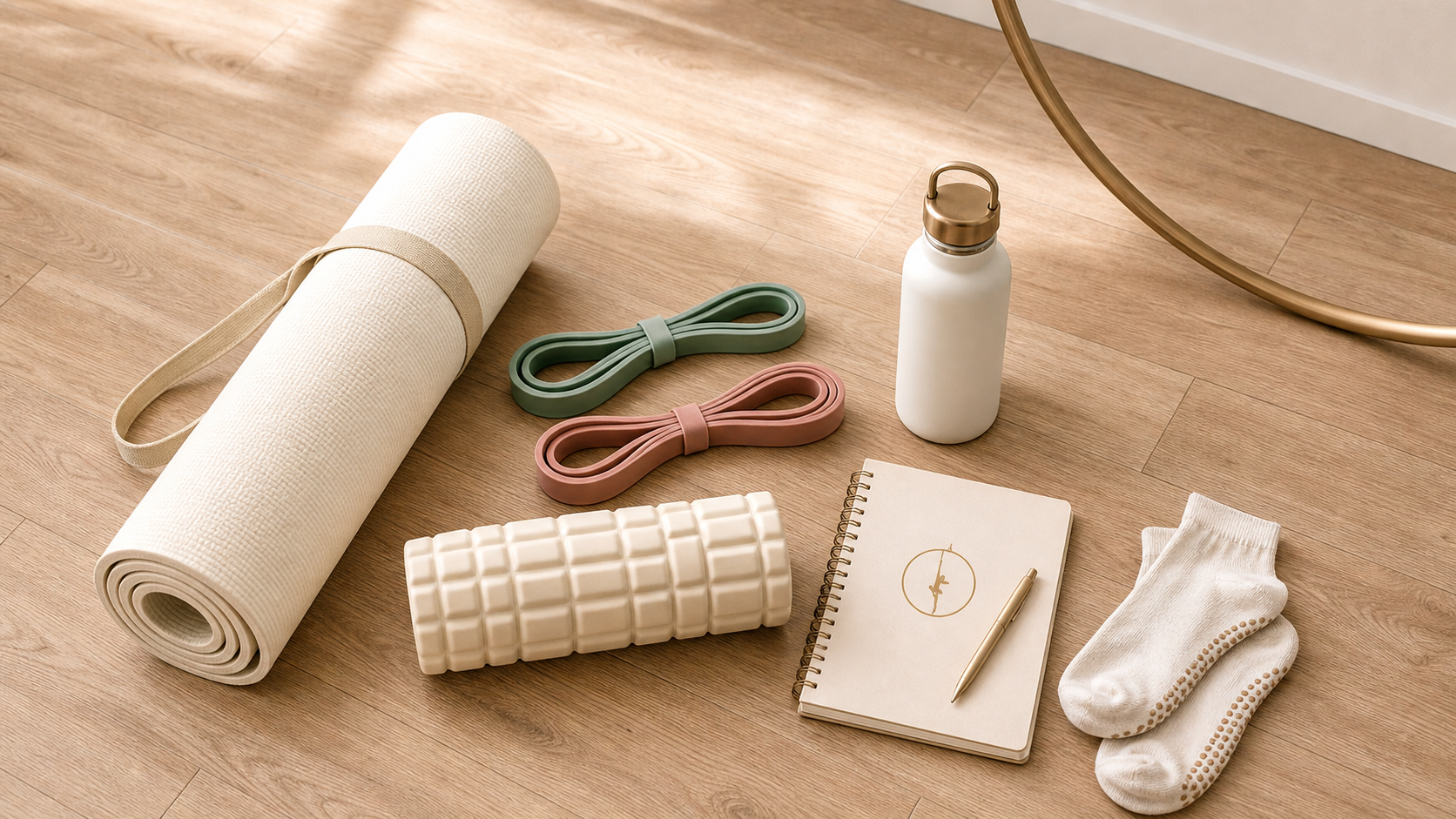
This article is the conditioning program I wish someone had handed me in my first year. It assumes no equipment beyond a yoga mat (a pull-up bar is a bonus, not a requirement). It targets the specific muscle groups aerial hoop actually uses, in the patterns it actually uses them. And it's structured so you can do it in your living room before bed.
If you take only one thing from this post, take this: train twice as much on the ground as you do in the air. The aerialists who follow that ratio progress faster, get hurt less, and look better doing it.
What aerial hoop actually demands from your body
Before listing exercises, it's worth understanding what we're conditioning for. Aerial hoop loads the body in a few distinct patterns, and useful conditioning hits all of them.
Hanging strength. Pull-up patterns, dead hangs, scapular control. Every entry, every climb, every drop runs through the shoulders and the muscles between the shoulder blades.
Core compression and hollow body. Hollow holds, V-ups, leg raises. When you invert, your core has to fold the body, hold the fold, and decelerate it. Aerialists with strong compression don't kick — they ascend.
Grip endurance. Not maximum grip strength — endurance. You don't need to grip a hoop with peak force; you need to hold a moderate grip for fifteen to forty-five seconds without your forearms quitting on you.
Hip and shoulder stability. Single-leg work, banded shoulder drills, Y-T-W raises. Aerial loads joints at the end ranges, and stability at the end ranges is what keeps you uninjured.
Posterior chain activation. Glutes, hamstrings, mid-back. Beautiful aerial lines come from the back of the body. Most beginners forget this and try to make everything happen with the front.
A good conditioning session touches three or four of these patterns. A great session rotates which three or four you hit so all five get covered across the week.
How often, how long, and how hard
Frequency. Two to three sessions per week, on non-class days. If you train aerial twice a week, condition twice a week. If you train aerial three times a week, condition twice. More than that and you'll start eating into your recovery.
Duration. Twenty to thirty minutes. Longer sessions don't produce proportionally better results at this stage and often crowd out actual aerial training.
Intensity. Hard enough that you couldn't keep talking comfortably, easy enough that you can complete the session with good form. If your form is breaking down, the session is over.
Recovery. At least one full rest day per week. Sleep is conditioning. So is hydration. So is eating enough protein.
A 30-minute home session, broken down
Here's a session you can run as-is or rotate through. It's structured in four blocks: warm-up, pull/push, core, posterior chain. The total time is intentional — long enough to be useful, short enough to actually do.
Block 1 — Warm-up (5 minutes)
- Cat-cow. 8 slow reps. Mobilize the spine.
- Shoulder CARs (controlled articular rotations). 5 in each direction, each side. Big slow circles with the arm.
- Hip CARs. 5 in each direction, each side.
- Scapular push-ups. 10 reps. Hands on the floor in a plank, arms straight, push the floor away to lift your upper back, then let it lower. Pure shoulder blade movement, no elbow bending.
- Dead hang. 20 seconds. If you have a pull-up bar, use it. If not, skip this and add 10 seconds to the next dead hang you do.
Block 2 — Pull / Push (8 minutes)
Aerial is dominated by pulling patterns, but balanced pushing keeps the shoulders healthy. Three rounds, minimal rest between exercises, 60 seconds rest between rounds.
- Inverted rows or banded rows. 8 reps. If you have a bar low enough to set up an inverted row (under a sturdy table works), use it. Otherwise loop a resistance band around a fixed point and row.
- Push-ups. 8 reps. Modify on knees if needed. Slow down — three seconds down, one second up.
- Scapular pull-ups (or scap pulls in a band). 8 reps. Hang from a bar with arms straight, then squeeze the shoulder blades down and together to lift the body slightly without bending the elbows. This is the single most aerial-specific drill outside of climbing the hoop itself.
Block 3 — Core (8 minutes)
Aerial core is not crunches. It's compression, anti-extension, and rotation control. Three rounds, 30–45 seconds per exercise, 30 seconds rest between rounds.
- Hollow body hold. Lying on your back, lower back pressed firmly into the floor, legs and shoulders lifted slightly so the body looks like a banana. Arms by ears or by sides depending on difficulty. This is the aerial core position. Build it up from 10 seconds to 60.
- V-up or tuck-up. 8 reps. From a hollow body, fold legs and torso to meet, then return to hollow.
- Side plank with hip lift. 8 reps each side. Build the obliques you'll need for asymmetric poses.
Block 4 — Posterior chain & finisher (5 minutes)
Glutes, hamstrings, and mid-back. The unsexy parts that make your aerial lines look intentional.
- Glute bridges. 12 reps. Slow.
- Single-leg deadlift, no weight. 6 reps each side. This is a balance and posterior chain drill.
- Y-T-W raises (lying face-down on a mat, lifting the arms in the shape of a Y, then T, then W). 8 reps of each shape. Tiny range. Slow tempo.
Block 5 — Cool-down (4 minutes)
Two minutes of light static stretching: chest doorway stretch, child's pose, supine spinal twist. Two minutes of slow nasal breathing — lower the heart rate before you walk away.
That's the whole session. Thirty minutes, no equipment beyond a mat and ideally a band, no hoop required.
Specific drills for specific aerial problems
If you're struggling with a particular skill, target the relevant pattern more aggressively in your home sessions.
"My inverts feel impossible." Compression is the bottleneck. Add a second set of hollow holds and V-ups twice a week.
"My forearms quit before my shoulders." Grip endurance. Add banded grip squeezes (60-second holds) at the end of every session, and extend dead hangs by 5 seconds each week.
"My shoulders feel unstable in mermaid / side balance." Lateral shoulder stability. Add side planks with shoulder taps, and add 8 reps of half-kneeling banded press per side.
"I can't hold a clean pose — I shake." Tonic stability. Hold every static drill 20% longer than feels comfortable. Trembling is information, not failure.
Recovery is conditioning
The fastest way to set yourself back is to condition hard, train aerial harder, and sleep five hours. Aerial gains compound during rest, not during the work.
The basics that actually move the needle:
- Sleep seven to nine hours. No supplement is a substitute for this.
- Eat enough protein. Roughly 1.6 grams per kilogram of bodyweight if you're training seriously. Most beginners undereat protein and wonder why their tissue feels fragile.
- Hydrate. Especially before training.
- Foam roll the lats and forearms. Five minutes a day. The lats run almost everything in aerial, and they get cranky when overtrained.
How to actually stick with this
Conditioning programs fail because they're too long, too complicated, or too disconnected from the work they're supposed to support. Three things that help adherence:
Tie it to a class day. Condition the day before or two days before your aerial class. The structure is automatic.
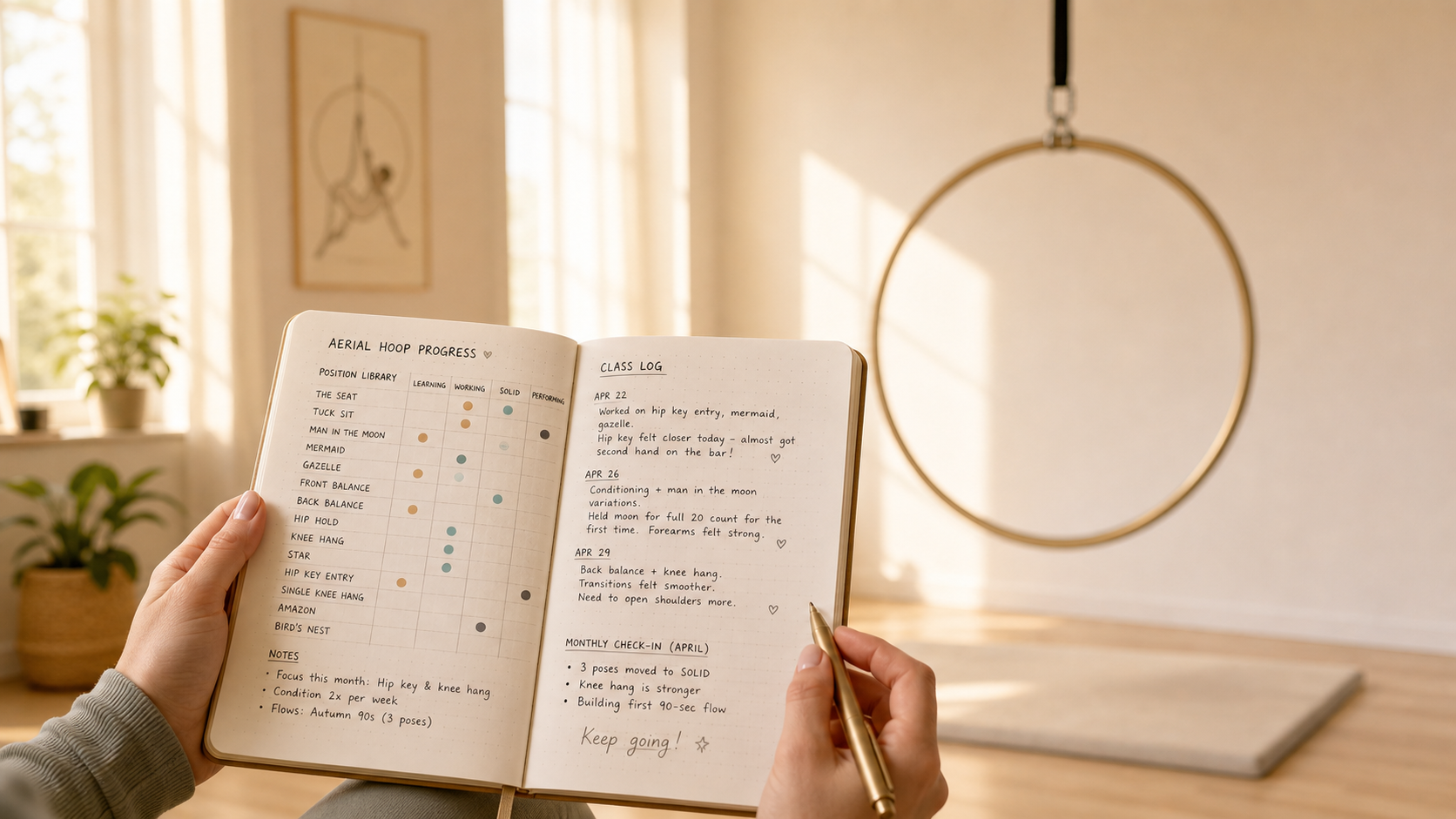
Track it. Even a one-line note — "Tuesday: did the session, hollow holds at 35 seconds, felt good" — is worth more than you'd think. Logging sessions inside the Aerial Hoop Flow app alongside your position library and training plans means your strength work and your aerial vocabulary live in the same place. You can see at a glance which weeks you conditioned consistently and which weeks you skipped — and the correlation with your aerial progress will tell its own story.
Lower the bar. A bad ten-minute session beats a perfect forty-minute session you skipped. If you've got ten minutes, do the warm-up and Block 3 (core). That's the most aerial-specific block of the program.
What to expect after eight weeks
If you condition twice a week for two months, here's a reasonable expectation:
- Hollow holds extend from 10–15 seconds to 45–60 seconds.
- Push-ups become noticeably easier.
- The first invert that used to feel impossible now feels merely difficult.
- The day-after-class soreness reduces.
- Your aerial flows look smoother because your stability has improved.
You won't suddenly become an elite aerialist. You will become someone whose body cooperates with what they're trying to do, which is the foundation everything else in aerial gets built on.
Show up twice a week. Keep the session short. Trust the work.
The hoop will reward you for it.