Aerial Hoop for Beginners: A Complete Guide to Starting Lyra
So you watched a performer spin slowly inside a steel ring, suspended somewhere between dance and gravity, and you thought: I want to do that. You're in the right place. Aerial hoop — also called lyra — is one of the most welcoming aerial disciplines for newcomers. It looks intimidating, but the entry curve is gentler than most people imagine.
This guide walks you through everything a complete beginner needs to know before their first class, after their first class, and through the first few months of training. By the end you'll know what aerial hoop is, what to wear, how strong you actually need to be, what to expect from a beginner curriculum, and how to keep progressing once you're hooked.
What is aerial hoop (lyra)?
An aerial hoop is a circular metal apparatus — usually steel, sometimes aluminum — suspended from a single rigging point or two points (a "single-point" or "double-point" hoop). You climb into it, sit on it, hang from it, drape over it, spin in it, and progressively learn shapes that make it look like the hoop is dancing with you.
The discipline goes by several names: aerial hoop, lyra, cerceau, or aerial ring. They all refer to the same apparatus. "Lyra" is the most common term in the United States; "aerial hoop" is more common in the UK, Australia, and continental Europe. If you're searching for classes locally, try both.
Aerial hoop sits in the same family as silks, trapeze, and aerial straps, but it has two big advantages for beginners. First, the hoop gives you something solid to sit on, hold onto, and brace against — it's far less ambiguous than a length of fabric. Second, the basic vocabulary of poses is built around shapes you can intuitively visualize: a "gazelle," a "mermaid," a "man in the moon." You can recognize each pose from across the studio, which makes learning them less abstract.
Do I need to be strong or flexible to start?
The single most common question beginners ask is "Am I strong enough?" The honest answer: probably yes, and the rest you'll build in the first eight to twelve weeks of regular training.
You do not need to do a pull-up to start. Most beginner curricula begin with floor-based exercises, low-hoop work (the hoop set so the bar is at hip or chest height), and assisted entries. Real strength gains happen because of training, not before it. The students I see progressing fastest are not the ones who walked in already strong — they're the ones who showed up consistently and conditioned a little between classes.
Flexibility is a bonus, not a requirement. Beginner shapes use a fairly neutral range of motion. As you progress into intermediate work, hip openness, shoulder mobility, and a soft back bend become more useful, but you'll develop them naturally through the work itself. If you want to accelerate that process, twenty minutes of yoga two or three times a week is more than enough at the beginner stage.
What you do need: patience, a willingness to be a beginner, and basic body awareness. You'll spend the first month learning to identify which muscles to engage when. The strength comes after the awareness.
What to wear to your first aerial hoop class
This is the second most-asked question, and there's a clear answer.
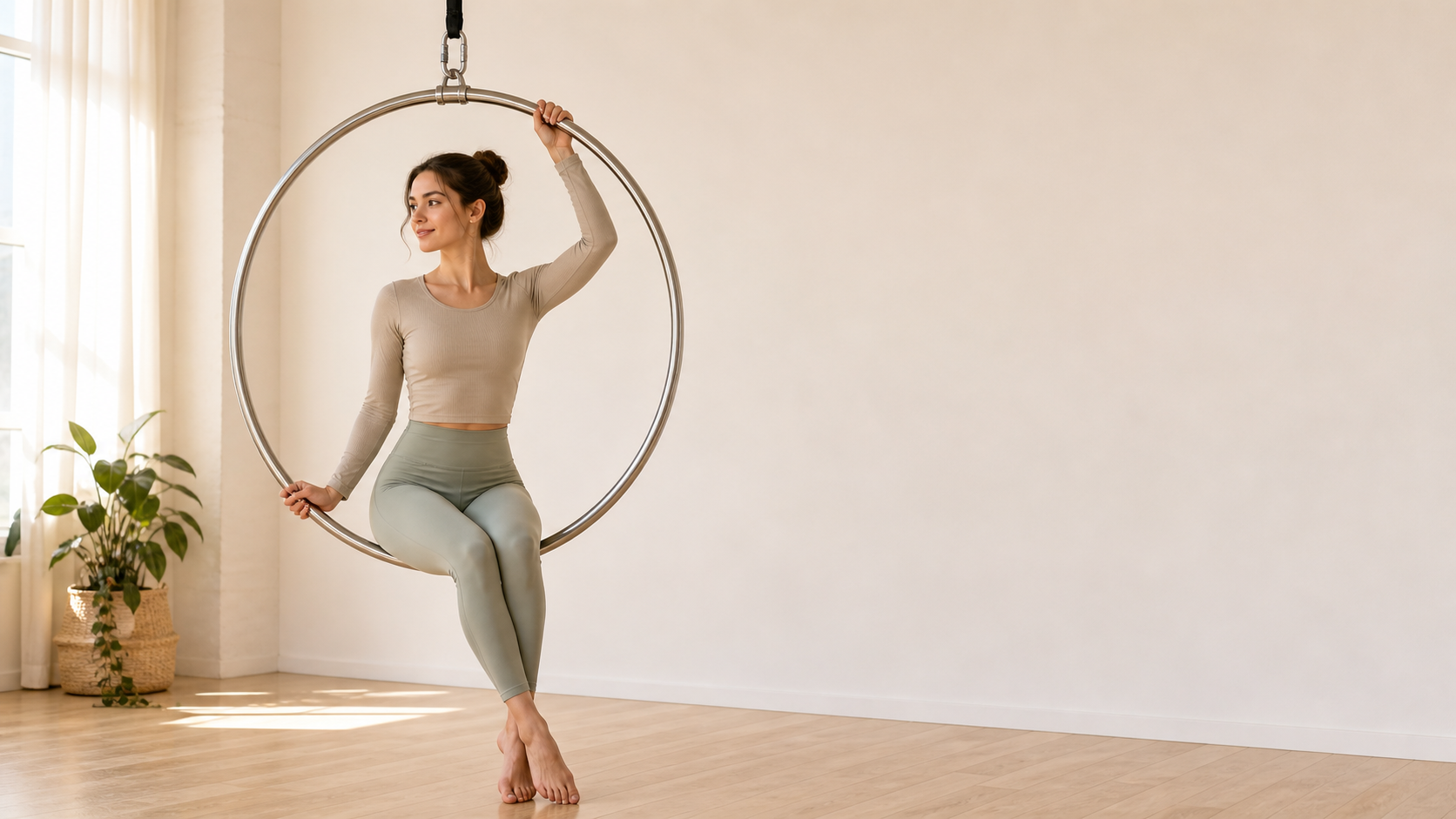
Cover your armpits, the backs of your knees, and your waistline. The hoop applies pressure exactly to these spots, and bare skin against bare metal will pinch and bruise faster than you expect. A fitted long-sleeve top tucked into mid-thigh or full-length leggings is the standard uniform.
Avoid zippers, buckles, hooks, large buttons, and exposed metal. They scratch the hoop and snag on the apparatus.
Remove jewelry. Rings, bracelets, watches, and dangling earrings all need to come off.
Skip lotion on training days. Slippery skin makes grip work harder and can be unsafe. If you must moisturize, do it the night before, not the morning of.
Hair tied back. Long hair gets caught on the hoop in spins and inverts.
You'll see experienced aerialists in cropped tops and shorts at some point. That's the body conditioning earned over years — leave it for later.
What a beginner class actually looks like
Most beginner aerial hoop classes follow a similar arc: warm-up, conditioning, hoop work, cool-down. Expect a class to run about 60 to 90 minutes.
Warm-up (10–15 minutes). General cardio, dynamic stretching, mobility for shoulders and hips. The instructor wants your tissue warm before you load it on the hoop.
Conditioning (10–15 minutes). Targeted strength: hollow holds, dead hangs, scapular pulls, leg raises. This is the unglamorous part that makes everything else possible. Don't skip it.
Hoop work (30–45 minutes). The instructor demonstrates a small set of skills, then you and the rest of the class take turns. In a beginner class the focus is usually on three things: how to enter the hoop safely, two or three foundational poses, and the transitions between them.
Cool-down (5–10 minutes). Stretching, decompression for the spine, light shoulder release.
You will probably feel awkward in your first class. Everyone does. Aerial requires you to load joints in unfamiliar directions and trust the apparatus, and trust takes a few sessions to build. Give it three classes before you decide whether you like it.
The first positions you'll learn
Beginner curricula vary by studio, but a few foundational shapes show up almost everywhere. These are the ones to expect in your first month:
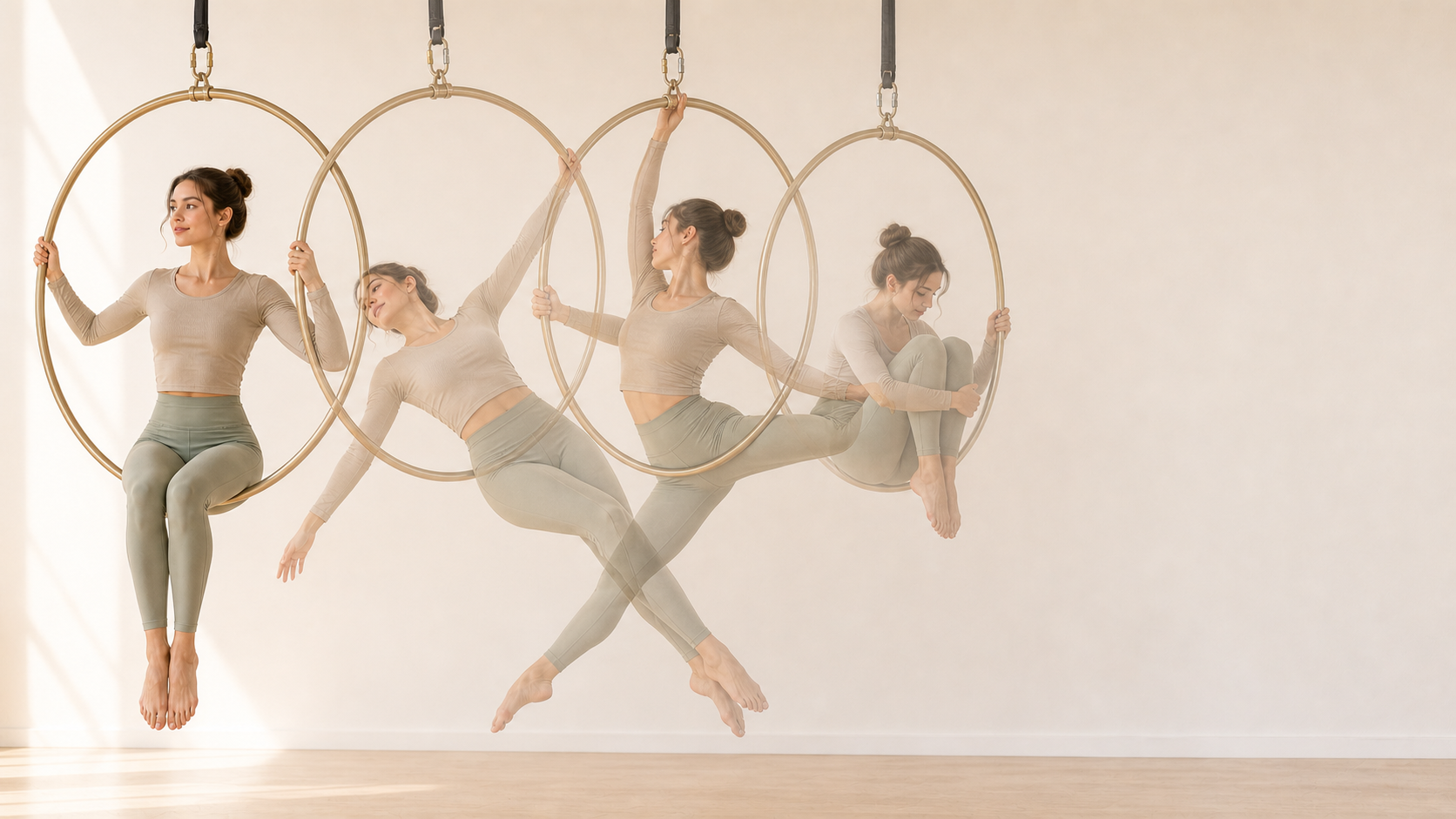
The Seat. Sitting on top of the hoop bar, hands gripping the sides at shoulder height. This is your home base. Every class will start and end here.
The Tuck Sit. From the seat, knees curled into the chest, feet hooked on the hoop bar in front of you. It looks small but it's a real core test.
The Man in the Moon. Lying along the bottom curve of the hoop, one leg hooked over the top, the other extended down — the silhouette resembles a crescent moon with a face. One of the first "photogenic" poses students learn.
The Mermaid. A side-lying drape across the bar with the legs together, the upper body lifted on a propped arm. Looks elegant, builds shoulder stability.
The Gazelle. A graceful split-leg pose with the body angled across the hoop. Requires a little flexibility and a lot of core control. Most beginners get a beginner-friendly version of this in the second or third month.
Front and back balance. Lying flat on your front (or back) across the hoop bar, balanced like a pencil. Sounds easy. Isn't.
A solid beginner library of fifteen to twenty positions is enough material for years of recombination. You don't need a hundred shapes — you need to know your shapes well.
How to keep progressing between classes
The students who improve fastest treat each class as a checkpoint, not the entire training plan. Between classes, three habits compound quickly:
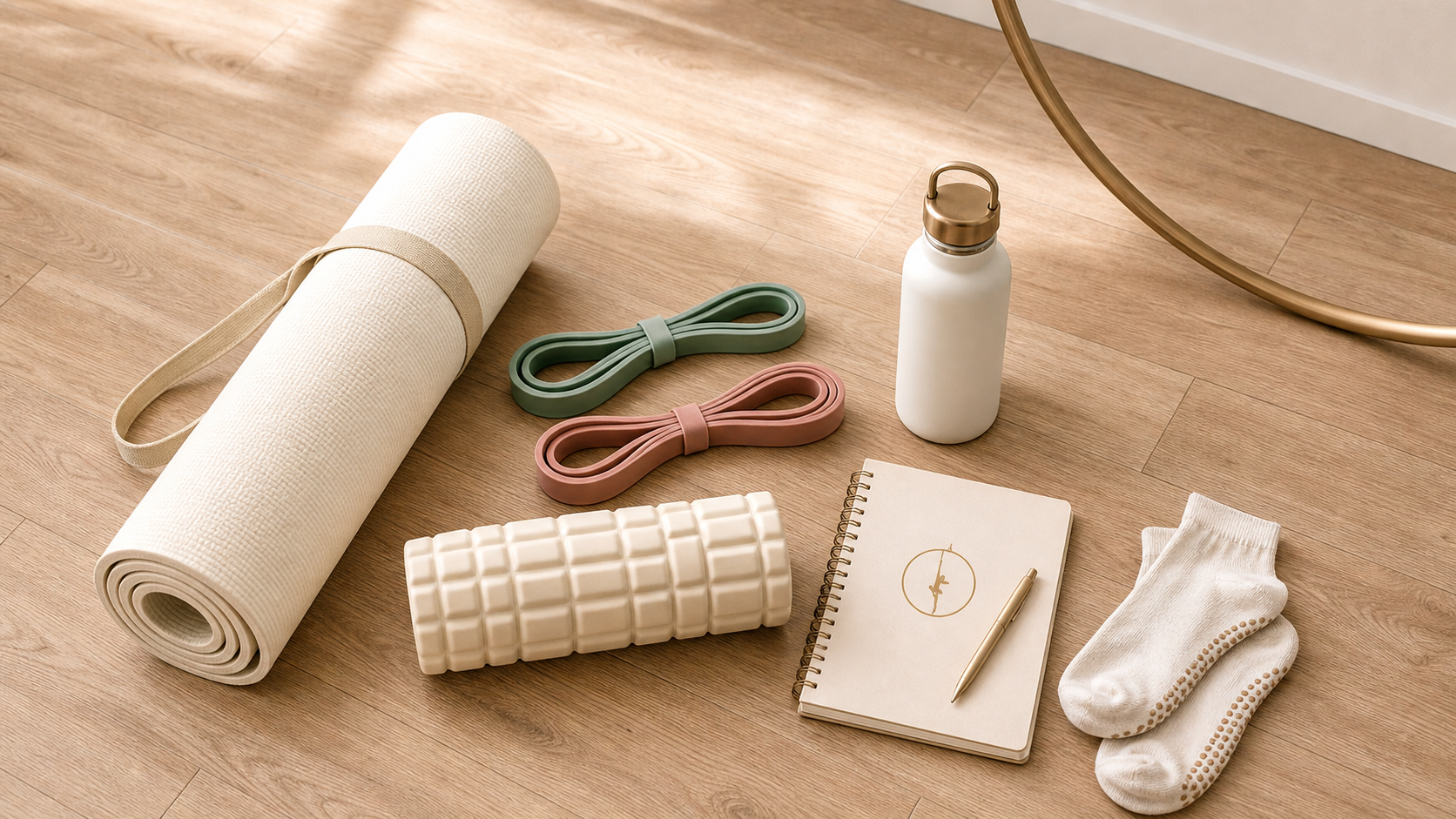
Condition twice a week. Twenty to thirty minutes is plenty. The list is short: hollow holds, dead hangs, push-ups, scapular pulls, leg raises, glute bridges. None of it requires a hoop.
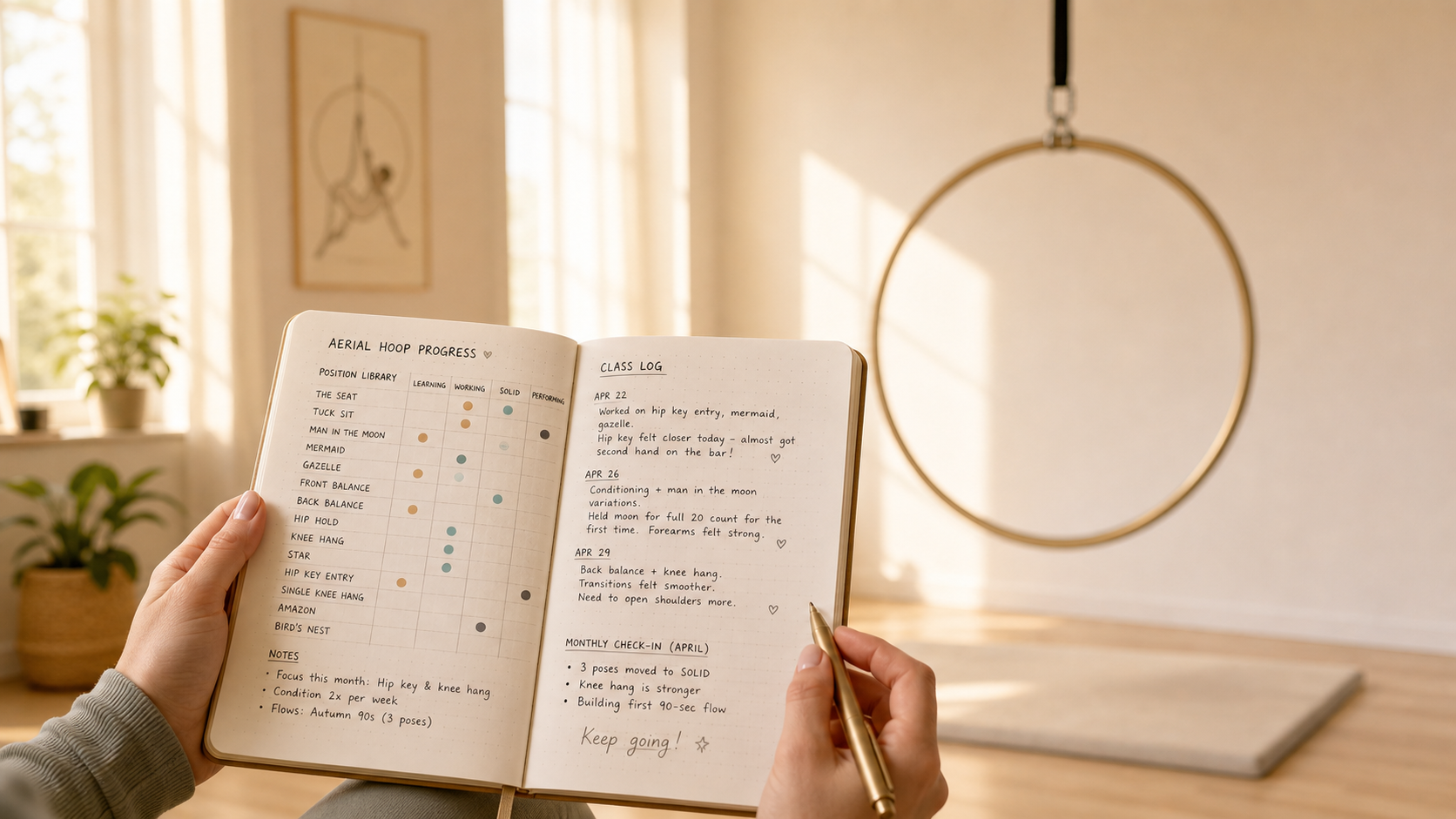
Take notes. After every class, write down what you learned, what felt hard, what your instructor cued you on. The names of the poses fade quickly otherwise. A dedicated training journal — paper, notes app, or a tool like the Aerial Hoop Flow app, which is built around tracking the 200+ positions you'll meet over the years — is one of the highest-leverage habits in this discipline.
Watch your own footage sparingly. Filming a single trick once a month is useful. Filming every attempt is exhausting and usually counterproductive. Aerialists who spend more time watching themselves than training tend to plateau.
How long until I'm "good"?
The honest answer is that "good" isn't a finish line — it's a moving target. But there are reasonable milestones.
Most students who train consistently for three months can confidently enter the hoop, hold five to eight foundational poses, and link two of them with a simple transition. They look like they know what they're doing.
At six to nine months, the inverts arrive. Hip-key entries, basic inversions, and the first taste of intermediate vocabulary. This is the stage where the apparatus starts to feel like an extension of your body rather than a foreign object.
By eighteen months, students who've trained twice a week and conditioned between classes are usually working through intermediate sequences, building short flows of three to five poses, and starting to think about choreography.
These are averages. Some people move faster. Some take longer. Comparing your timeline to anyone else's is the surest way to make this feel worse than it should.
Safety, in plain language
Aerial hoop is statistically very safe when practiced under instruction with proper rigging and crash mats. It is not safe when practiced without those things. Three rules that should never bend:
- Never train new skills alone. Your first hundred classes happen in a studio with an instructor and a mat.
- Don't buy a home rig until you're an intermediate aerialist. Rigging is structural engineering, not a craft project.
- Listen to pain. Sore the day after class is normal. Sharp pain mid-skill is a stop sign, not a hurdle.
You can do this
Most people who try a beginner aerial hoop class show up nervous, leave smiling, and book the next one before they've left the studio. The discipline rewards consistency more than talent. If you can show up once a week for three months, you will be doing things you didn't think your body could do. That's not marketing — that's just what happens.
When you're ready to keep your training organized — log positions you've learned, build personal training plans, and share routines with your coach — try the Aerial Hoop Flow app. It's the tool I wish I'd had when I started.
Welcome to the hoop.